
By
Super User
Best Travel Guide To Lake Bogoria Wildlife In Northern Kenya
Best Travel Guide To Lake Bogoria Wildlife In Northern Kenya
Lake Bogoria is famously known for its hot springs, geysers, and huge amounts of lesser flamingos. Lake Bogoria, formerly known as Lake Hannington is a saline, alkaline lake that lies in a volcanic region in a half-graben basin south of Lake Baringo in northern Kenya, north of the equator. Lake Bogoria, like Lake Nakuru, Lake Magadi, and other Rift Valley Lakes, is home at times to one of the world's largest populations of lesser flamingos.
The lake is a Ramsar site and Lake Bogoria National Reserve has been a protected National Reserve since November 29, 1973. Lake Bogoria is shallow approximately 10 m depth, with a drainage basin of 700 km2. Lake Bogoria is famed for its geysers, and its huge population of flamingos, which come to feed on algae and drink fresh water from lakeside spouts.
The lake itself is highly alkaline and twice as salty as seawater; it can’t support fish. But it has a secret wealth that is only now beginning to be tapped: The lake contains an unusual array of microbes and microorganisms from which enzymes have been produced for use in antibiotics and cleaning products.
Local features include the Kesubo Swamp to the north and the Siracho Escarpment to the east, both within the National Reserve. The lake is also famous for geysers and hot springs along the bank of the lake and in the lake. In four locations around the lake can be observed at least 10 geysers, which erupt up to 5 m high. Geyser activity is affected by the fluctuations of lake level, which may inundate or expose some geysers.
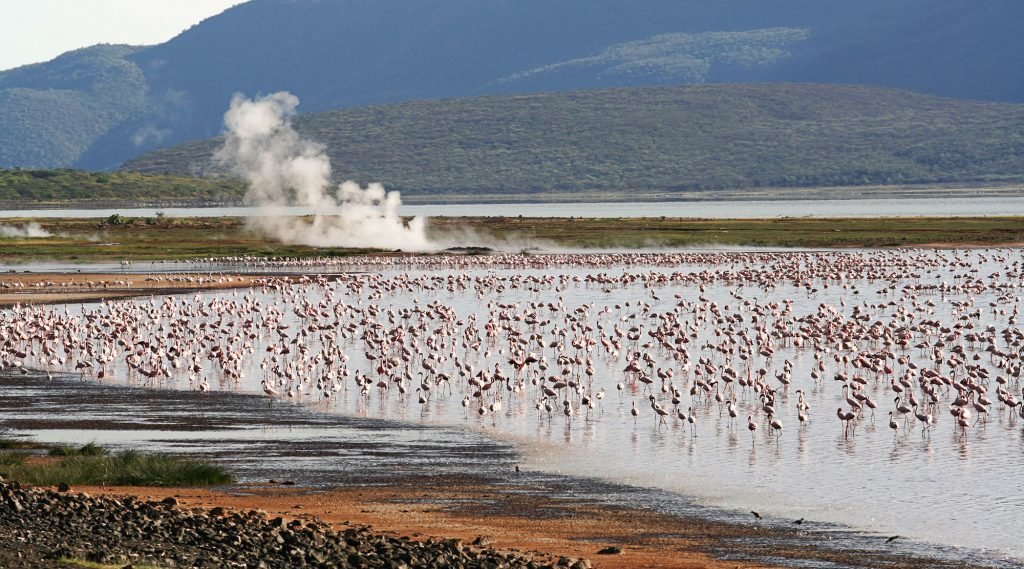
The lake waters contain large concentrations of sodium, bi-carbonate, and carbonate ions which originate from the inflow of the Sandai and Emsos rivers, and from about 200 alkaline hot springs that are present at three onshore sites: Loburu, Chemurkeu, and a southern group - Ng'wasis, Koibobei, Losaramat, with other springs discharging directly from the lake floor.
Lake Bogoria also contains the highest concentration of true geysers in Africa with at least 18 known geysers. The lake has no surface outlet so the water becomes saline mainly through evaporation, which is high in this semi-arid region. Although hypersaline, the lake is highly productive with abundant cyanobacteria that feed the flamingoes, but few other organisms inhabit the lake.
The lake has not always been saline. Sediment cores from the lake floor have shown that freshwater conditions existed for several periods during the past 10,000 years and that the lake level was up to 9 m higher than its present elevation of about 990 m. At times it might have overflowed northward towards Lake Baringo. At times, during the late Pleistocene, it might have been united with a larger precursor of modern Lake Baringo, but this is still uncertain.
Raptors such as tawny eagles prey on the flamingoes. In total, 135 species of bird have been recorded. They include little grebe, pratincole, swift, little bee-eater, cape wigeon, yellow-billed stork, African spoonbill, augur buzzard, Gabar goshawk, water dikkop, great tit, starling, hornbill, and others.
The reserve also has a herd of the relatively uncommon Greater Kudu. Other large mammals include buffalo, zebra, cheetah, baboon, warthog, caracal, spotted hyena, impala, and dik dik.
Many visitors are attracted to the hot springs on the western lakeshore, and these cause pollution from solid wastes. Siltation is another threat to biodiversity. Lake Bogoria also has deep spiritual and cultural significance for the Endorois people, who have lived beside, and been custodians of the lake for centuries.
Hotel accommodation is available near Loboi village at the north end of the lake. Camping is permitted at the southern end of the lake.
Arrange with Ultimate Wild Safaris for a beautiful expedition to Lake Bogoria in northern Kenya.
Email: This email address is being protected from spambots. You need JavaScript enabled to view it.
Mobile: +256 705 087 906 / 760 282 342


