
By
Super User
Best Travel Guide To Lalibela Rock-hewn Churches Safari Adventure In Ethiopia
Best Travel Guide To Lalibela Rock-hewn Churches Safari Adventure In Ethiopia
Discover the unique and breathtaking beauty of Lalibela Rock-hewn churches, and experience the rich cultural heritage of Ethiopia.
The 11 Rock-hewn Churches of Lalibela, Ethiopia are medieval monolithic churches carved out of a mountainous region, about 645 km from Addis Ababa, the Capital of Ethiopia Their building is attributed to King Lalibela who set out in the 12th century to recreate ‘New Jerusalem’ in his own Kingdom, after Muslim conquests halted Christian pilgrimages to the Holy Land.
These extraordinary collections of rock-hewn churches are steeped in mystery and each has a unique style.
Lalibela's churches are unique in that they are hewn from a single piece of living rock. Instead of rising above ground level, they stand in sunken pits with their roofs on the same level as the surrounding landscape.
Located in the Amhara region of northern Ethiopia, the 11 rock-hewn churches of Lalibela have been called the Eighth Wonder of the World and were named a UNESCO World Heritage Site in 1978. The churches were hewn from the living rock of monolithic blocks. These blocks were further chiseled out, forming doors, windows, columns, various floors, roofs, etc. This great work was further completed with an extensive system of drainage ditches, trenches, and ceremonial passages, some with openings to hermit caves and catacombs. It took 24 years to build all 11 rock-hewn churches.
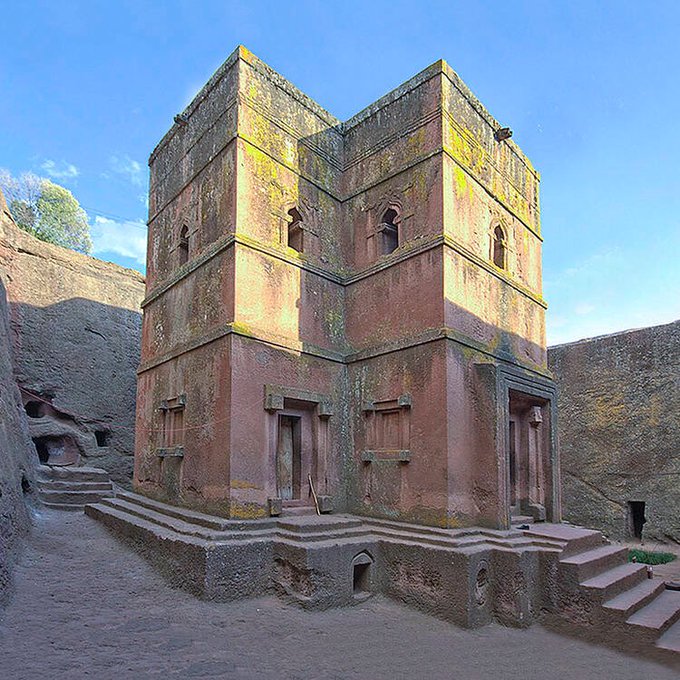
All the 11 churches represent a unique artistic achievement, in their execution, size, variety, and braveness of their form. These 11 churches are; Biete Medhani Alem (House of the Saviour of the World), Biete Mariam (House of Mary), Biete Maskal (House of the Cross), Biete Denagel (House of Virgins), Biete Golgotha Mikael (House of Golgotha Mikael), Biete Amanuel (House of Emmanuel), Biete Qeddus Mercoreus (House of St. Mercoreos), Biete Abba Libanos (House of Abbot Libanos), Biete Gabriel Raphael (House of Gabriel Raphael), and Biete Lehem (House of Holy Bread) and Biete Ghiorgis (House of St. George) which is isolated from the rest, but still connected by a system of trenches.
Biete Medhani Alem (House of the Saviour of the World), with its five aisles, is believed to be the largest monolithic church in the world, while Biete Ghiorgis(House of St. George) has a striking cruciform plan and were probably used as churches from the beginning, but Biete Mercoreos and Biete Gabriel Rafael may formerly have been royal residences as much of their interiors are decorated with mural paintings.
Also close to the churches, in the village of Lalibela are two traditional story round houses, built of local red stone, with interior staircases and thatched roofs and known as the ‘Lasta Tukuls’. The whole of Lalibela offers an exceptional testimony to the medieval and post-medieval civilization of Ethiopia.
The site remains in use by the Ethiopian Orthodox Christian Church to this day. These exceptional churches have also been the focus of pilgrimage for Coptic Christians since the 12th century.
The Rock-Hewn Churches of Lalibela are still preserved in their natural settings. The association of the rock-hewn churches and the traditional vernacular circular houses, in the surrounding area, still demonstrate pieces of evidence of the ancient village layout. The original function of the site as a pilgrimage place persists and provides evidence of the continuity of social practices. The intangible heritages associated with church practices are still preserved.
Lalibela with all these sights should be a top destination for anyone’s visit to Ethiopia.
Arrange with ULTIMATE WILD SAFARIS for this wonderful expedition.
Email: This email address is being protected from spambots. You need JavaScript enabled to view it.
Mobile: +256 705 087 906 / 760 282


