
By
Super User
Best Travel Guide To Tree Climbing Lions in Queen Elizabeth National Park
Best Travel Guide To Tree Climbing Lions in Queen Elizabeth National Park
Situated in the south section of Queen Elizabeth National Park, the Ishasha sector is popularly known for its tree-climbing lions. Alongside the northern part of Tanzania, the Ishasha sector is among the only known two places in Africa where you can view tree-climbing lions.
Away from mountain gorillas, lions are the second most sought-after species in Uganda. The Wildlife Conservation Service assessment estimated that each lion in Queens generated around $13,500 per year for Uganda’s economy in terms of revenue brought to the country.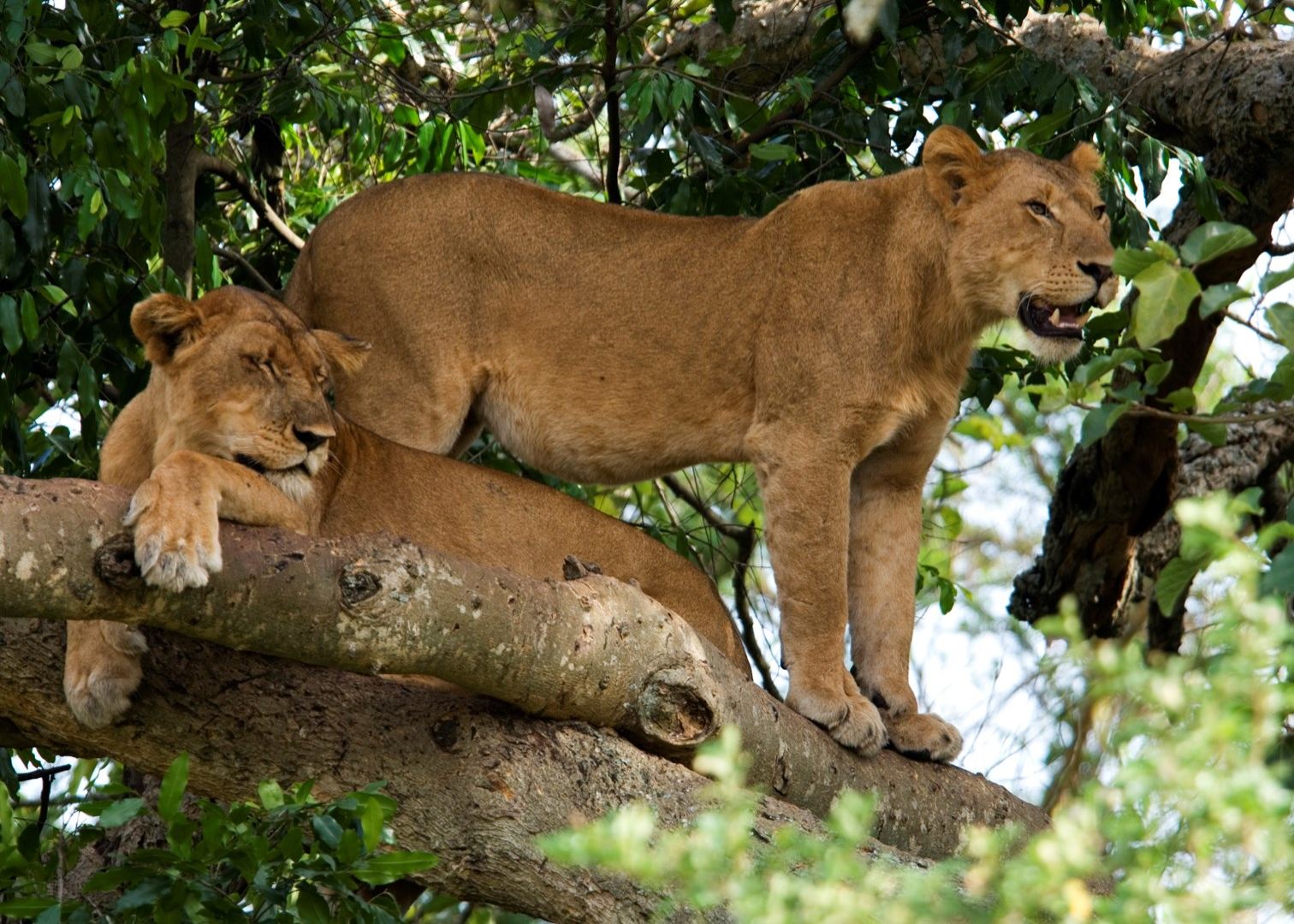
Why do lions climb trees?
Research shows that tree climbing is a behavioural adaptation, rather than a product of evolution.
Scientists think that the lions have adopted this bizarre behaviour as a way to get away from the disturbances brought by bites from tsetse flies.
Other theories suggest that lions climb trees to get away from the high temperatures of the ground plains. Tree branches give them shade from the burning day sun, allowing them to enjoy an afternoon nap in comfort.
Also, lions hanging in the tree branches serve as an added advantage viewpoint when hunting.
How many lions are in Queen Elizabeth National Park?
In 2005, the Wildlife Conservation Service launched a lion monitoring project in the Ishasha sector of Queen Elizabeth National Park. The project found that 20 to 35 lions habit within the Ishasha sector.
The research showed that male lions tend to move freely between Uganda and the Democratic Republic of the Congo when leaving their pride. Male lions are excluded from the pride at the age of 3-4 years by the pride-dominant male.
The study also showed cases of lions travelling from the Democratic Republic of the Congo to lead a pride in Uganda, and vice versa.
The study showed that the Maramagambo Forest is the most used migratory route for lions that travel from the central sector of Queens to the Ishasha Sector.
Game drives in the Ishasha Sector
Although tree-climbing lions are the main attraction in the Ishasha sector, it is also home to other standing-out mammals, including Ugandan kobs, buffaloes, elephants, and zebras.
The Ishasha sector is the best location for game drives as it is a quieter section of the park. You can enjoy the sights and sounds of the vast plains without the disturbance of other safari car sounds.
Your constant see of the plains will not be spoiled by the sound of vehicles. The absence of traffic means that you can spend more time with the lions.
However, the roads are less well maintained than the park's busier sections, so a good 4x4 vehicle and a well-knowing guide are needed (if arranged with us, this will be done for you).
Threats to Lions in Queen Elizabeth National Park
The lion population in the Ishasha sector has been declining over the last few years. The Wildlife Conservation Service approximates that the number of lions has declined from 6 lions per 100km² to 4 lions per 100km² in the last 10 years.
Human encroachment is a major threat to lions in Ishasha. The conflict between lions and local herdsmen is common. Local herdsmen often leave their cattle unlooked after at night, and lions have been known to attack their livestock.
Some herdsmen revenge by poisoning the dead meat of their livestock and in 2018, 11 lion carcases were found in Ishasha. Insecticide poison was found in their bodies.
The Wildlife Conservation Service is working tirelessly to solve the human-lion conflict. The WCS has put up land outside the park, allowing herdsmen to move to fertile grazing lands outside the territory of the lions.


